Online Marketing Tips
Short, Concise Online Business Tips From a Variety of Topics
 My OneClick copy feature saves you valuable time and ensures accuracy when using these tool recommendations across your content. Click on any "OneClick Copy" button to choose from four ready-to-go formats and the content is immediately stored to your computer's clipboard. Then just paste the ready-to-go content wherever you need it.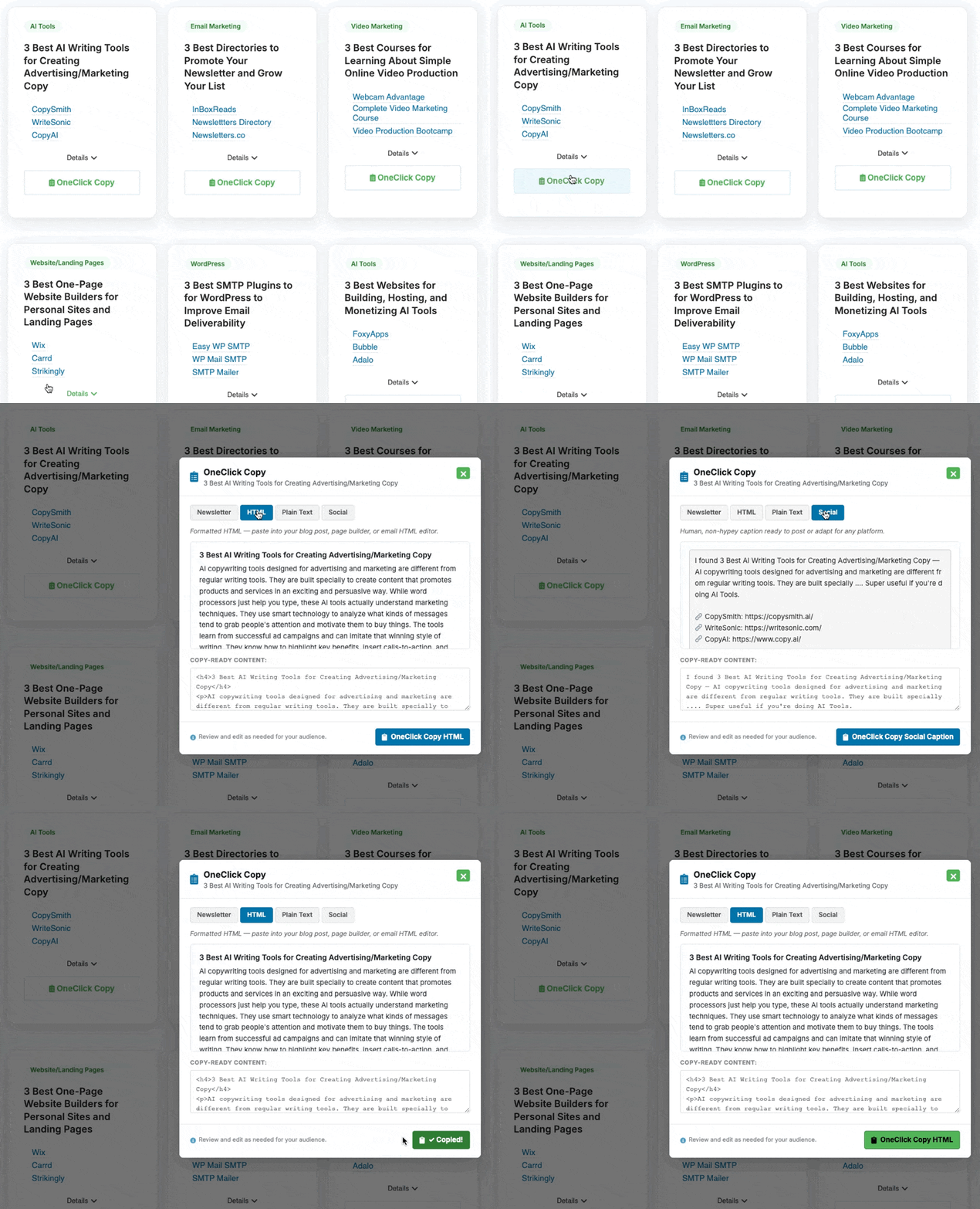
AI Can’t Replace Human Connection
People follow creators for personality, relatability, and authenticity. AI can’t replicate that. If your content feels automated and soulless, people will disengage. Use AI to speed up production, but never at the expense of connection. Your voice, your stories, your humanity—that’s what builds an audience. AI is the assistant, not the creator.
Stop Guessing, Start Asking
- Send a survey. Ask what they’re struggling with. Use their responses to create content and products.
- The best product ideas come from direct requests, not your brilliant hunches.
- Interview your best customers. Find out why they bought and what made them hesitate.
- Your audience will literally tell you what to sell them. You just have to ask.
- Every complaint is a product opportunity. Every question is a content idea.
- Stop inventing problems to solve. Solve the ones people already have.
- Validation before creation saves you months of wasted effort.
People Buy With Emotion, Justify With Logic
- Facts tell. Stories sell.
- Hit the emotional desire first, then support with logical reasons.
- People want the feeling: confidence, relief, freedom, success.
- Give them the emotion. Back it up with proof.
- Logic is necessary. Emotion is what drives action.
- Make them feel something. Then show them why it makes sense.
- Emotion first. Logic second.
Most People Need to See Your Offer 7+ Times Before Buying
- One email or post won’t convert most people.
- Repetition isn’t annoying if your message adds value each time.
- Talk about your offer from different angles: benefits, objections, testimonials, use cases.
- Most beginners give up after one or two promotions. Don’t.
- Consistent promotion is necessary. Annoying promotion is repetitive without value.
- People are busy. They need reminders.
- Don’t assume they remember. Keep showing up.
Your Competitors’ Mistakes are Your Advantages
- Study what your competitors do wrong. Then do it better.
- Bad customer service? Make yours exceptional.
- Confusing website? Make yours clear.
- Slow response times? Respond fast.
- Gaps in their content? Fill those gaps.
- Every weakness they have is an opportunity you can exploit.
- Don’t just copy competitors. Improve on what they’re failing at.
People Unsubscribe. That’s Okay.
- Not everyone will stay on your list forever. Some will lose interest. Some will move on. That’s normal.
- Unsubscribes aren’t personal. They’re a natural part of list maintenance.
- A smaller, engaged list is better than a bloated one full of people who don’t care.
- If someone unsubscribes, they were never going to buy anyway. Let them go.
- Focus on the people who stay, not the ones who leave.
- High unsubscribe rates after a specific email? That’s feedback. Adjust and move on.
- Your list should be full of people who want to be there. Quality over quantity.
Overnight Success Is a Myth
- The creators who look like they “blew up” overnight usually worked in obscurity for months or years first.
- You’re seeing their breakthrough moment, not the grind that led to it.
- Sustainable growth is slow. Expect months before you see meaningful traction.
- If you’re not getting views, subscribers, or engagement in your first three months, you’re normal.
- Patience isn’t optional in content marketing. It’s required.
- The people who quit early are the ones who expected instant results. Don’t be them.
- Keep going. The results are coming—they’re just slower than you’d like.
Use AI for Keyword Research
Ask AI: “What are 20 keywords people search for about starting a blog?” It generates a list based on common search patterns. You validate with actual keyword tools. AI gives you a head start on research.
Use AI to Research Competitors
Describe your niche to AI and ask: “What are common strategies used by successful marketing educators?” AI will summarize trends, tactics, and approaches based on its training data. This isn’t a substitute for real competitor research, but it gives you a head start. Use AI for initial insights, then verify with actual observation.
What Your Audience Actually Cares About
Your audience doesn’t care about your qualifications, your process, or how hard you worked. They care about one thing: Can you solve their problem? Everything you create should answer that question. Talk less about yourself and more about their struggle. Show you understand what keeps them up at night. Position your offer as the bridge between their pain and their desired outcome. When you make it about them, not you, marketing gets easier.
AI for Market Research
Ask AI: “What are the top concerns of people learning social media marketing for the first time?” or “What objections do beginners have about starting a blog?” AI synthesizes patterns from its training data and gives you insights. This isn’t a replacement for talking to real people, but it’s a fast way to identify likely pain points, questions, and objections. Use AI for initial research, then validate with your actual audience.
Subject Lines Matter More Than You Think
The best email in the world doesn’t matter if no one opens it. Your subject line is the gatekeeper. Keep it short, clear, and curiosity-driven. Avoid clickbait, but don’t be boring either. Test different approaches: questions, statements, benefits, intrigue. Pay attention to what gets opened. Subject lines are a skill you develop over time, so don’t stress if your first ones flop. Just keep testing and refining.
Solve One Problem Really Well
- Don’t try to be everything to everyone.
- Pick one specific problem your audience has. Solve it exceptionally.
- “I help coaches get their first 100 email subscribers” beats “I do marketing.”
- Depth beats breadth every time.
- Master one problem before adding another.
- Specialists earn more than generalists.
- One problem, one solution, massive focus.
Automate the Repeatable, Personalize the Important
- Automate welcome emails, follow-up sequences, and scheduling.
- Personalize sales conversations, onboarding calls, and customer support.
- Automation saves time on tasks that don’t require your unique touch.
- Personalization builds relationships in moments that matter.
- Don’t automate everything. Some things need a human.
- Use automation to scale. Use personalization to connect.
- Balance efficiency with authenticity.
The First Draft Is Supposed to Be Messy
- Your first version will be rough. That’s not a sign you’re bad at this—it’s a sign you’re doing it.
- Editing is where the magic happens. Writing is just getting ideas on the page.
- Don’t judge your first draft. Its job is to exist, not to be good.
- Most great content started as rambling, incoherent nonsense. Then it got refined.
- Give yourself permission to write badly. You can fix bad. You can’t fix blank.
- Finish the draft. Then improve it. Trying to do both at once is paralyzing.
- Progress means publishing imperfect work, not endlessly polishing invisible drafts.
Internal Linking Helps (And It’s Easy)
When you write a new blog post, link to other relevant posts on your site. This helps Google understand how your content connects and keeps readers on your site longer. It’s simple: if you mention email marketing in a post about content strategy, link to your email marketing guide. Internal links signal to search engines that you have depth on a topic. Plus, they guide readers to more of your content, which increases engagement. Don’t overthink it—just link where it makes sense.
Free Content Builds Trust. Paid Products Build Income.
- Give away your best ideas for free. Sell implementation, support, and convenience.
- Free content attracts. Paid products convert.
- You’re not giving away the farm. You’re planting seeds.
- People who consume your free content and find value will pay for more.
- Don’t hold back in free content. Generosity builds audiences.
- Free content markets your paid products. It’s not a replacement.
- Be generous. It pays off.
Content Builds Trust Before It Builds Sales
- Most people won’t buy from you the first time they see your content. They need time to trust you.
- Content is how you prove you know what you’re talking about and genuinely want to help.
- Think of content as a long game. You’re planting seeds, not demanding immediate harvests.
- The more value you provide upfront, the easier it is to sell later.
- People buy from brands they trust. Content builds that trust.
- Don’t expect instant ROI from every piece of content. Expect cumulative impact over time.
- Trust first. Sales second. Always.
You Don’t Need to Rank #1 for Everything
Ranking on the first page of Google (even positions 3-5) brings traffic. You don’t need the top spot to succeed. Ranking #1 for one keyword is great. Ranking #5 for ten keywords is better. Focus on creating lots of helpful content on related topics rather than obsessing over one perfect ranking. Cumulative traffic from multiple “good enough” rankings adds up faster than waiting for one #1 spot.
Search Tips Listings:
Become a Platinum Member and Get Access
to Over 4,000 OneClick Copy Resources
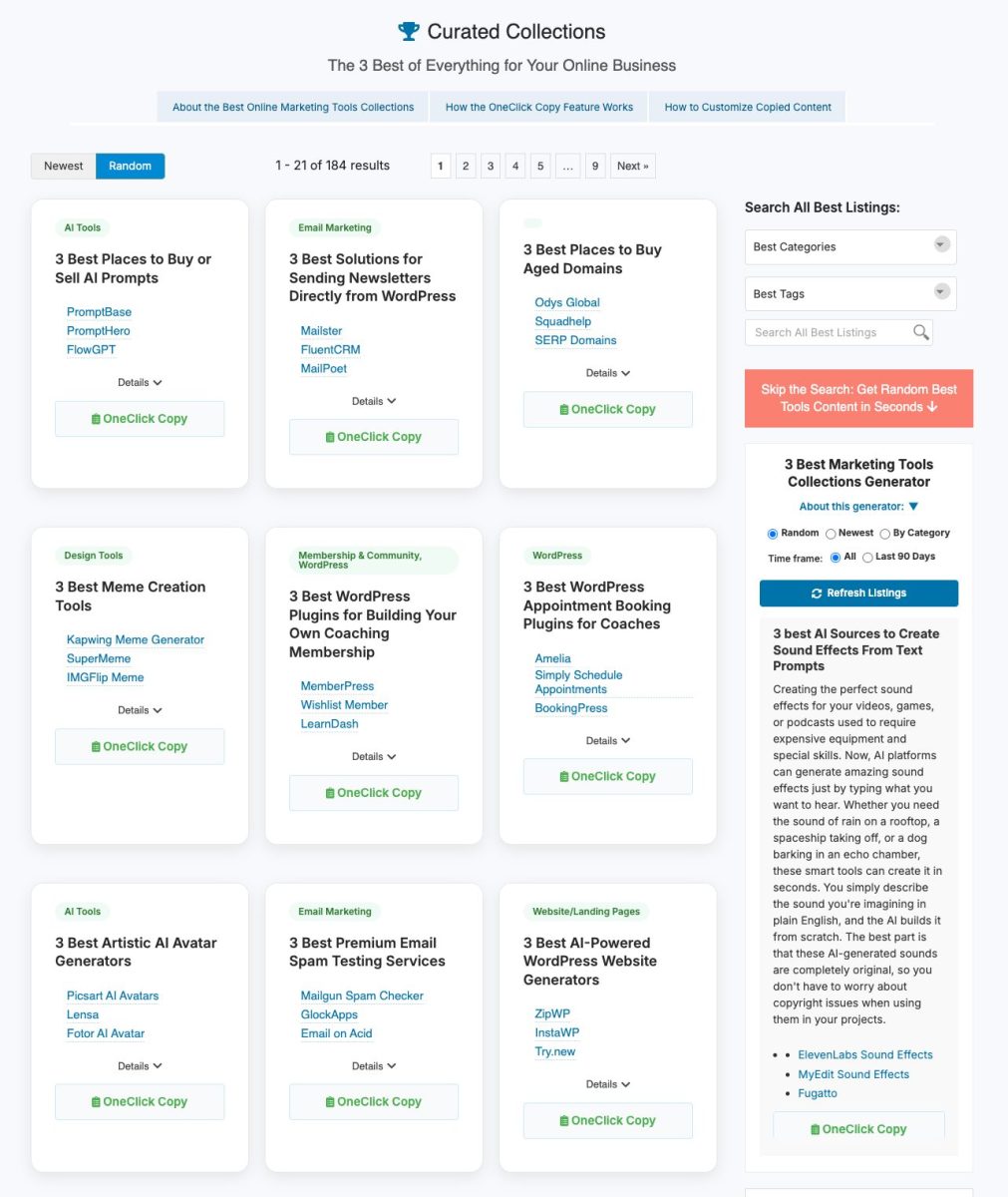
Normally, there would be a gigantic directory here of hundreds of marketing resources that you can quickly copy for your own use with my OneClick Copy feature. Free members have unlimited access to the 9 random content generators — a genuinely useful starting point. But "random" is the key word. You have no control over what comes up, what category it's from, or how recent it is. Our Platinum Members have access to this directory and eight others that are fully searchable, and organized by category, keyword, and date. Everything is formatted and ready to paste. Click Here to learn how.